Showing posts with label freedom. Show all posts

Sunday, November 11, 2012

Are sinners allowed to adopt?


  1. The Catholic Church has long decried homosexual acts as sinful, and neither acknowledges nor condones homosexual marriages. 
  2. They also oppose legal marriage rights for gay couples and seem particularly vehement in their opposition to adoption. 

I just feel the need to point out that 2 by no means follows from 1.

Making claims about what is and is not sinful is standard issue; the Church has been at that for a long time, and wont be stopping any time soon.  Furthermore, it seems clear to me that it is within the rights of the Church to refuse the sacrament of marriage, or any sacrament for that matter, to anyone for failing to meet certain theologically determined criteria.  I don't find the Church's position on the sinfulness of homosexuality terribly compelling, but I'm willing to let the ongoing deliberation and prayer of the Church to sort out which of us is in the right.

However, 2 has no bearing on any of those things.  Legal rights are inherently secular, and to the extent that they are above and beyond the protections espoused by the church, seem to me to be beyond reproach.  This is especially true given the Church's theological commitment to freedom of religion: there are faiths that permit or even laud gay marriage.  If the church is committed to true religious freedom, it is imperative that other faiths be permitted to operate with the same legal capacities and protections as the Catholic Church.

All of that, however, is sideshow stuff compared to the Church's scandalous position on adoption by gays.  The Church has no massive public campaign objecting to adoption by remarried couples; to my knowledge it has no animosity at all to such adoptions.  But, from a Catholic theology perspective, such people are also publicly engaged in mortal sin.  For reasons that escape me, the Church has decided that it is more important to punish and restrict a particular class of sinners than it is to provide loving homes to orphans. I find myself disgusted by my Mother Church's insistence that it prefers keeping children in foster care and orphanages to permitting them to be loved, raised, and cared for by a sinning couple.  If any fellow Catholics have a thoughtful dissent to this sentiment, I'd love to hear it.

Monday, February 13, 2012

What should a liberal arts education provide?

So my broad understanding is that there are two important components to education.  On the one hand, education is vocational: that is you learn skills relevant to a profession.  On the other hand, education is liberal: that is you learn skills relevant to life as a free person.  It seems to me that we've lost sight of the second goal, that the current liberal education is a historical artifact that has lost its most useful characteristics and kept its outdated ones, and that our educational institutions owe it to us to have a rethink along the lines I describe.

Wikipedia has some historical background on this that seems relevant to my rant.  For those of you who hate clicking links or fear Wikipedia, the liberal education (the education for free people, as opposed to for slaves), was basically verbal reasoning enshrined in the Trivium of Grammar, Logic, and Rhetoric, and (eventually, once we got to the middle ages) mathematical reasoning enshrined in the Quadrivium of Geometry, Mathematics, Music, and Astronomy.  It's worth mentioning that the Quadrivium is probably better understood as Statics, Number Theory, Ratios, and Mechanics, but they used useful proxies for the names instead.  Whatever.  It seems that between the Trivium and the Quadrivium we have basically all the tools necessary to explore the depth and breadth of human achievement.  That makes sense, since that's basically the point of having a liberal arts education - to give you the tools to understand and contribute to discourse in the free world.

Now, it seems to me that while the tools described in the Quadrivium enjoy broad support and advocacy in education, they are the least useful, and indeed increasingly antiquated, tools.  The Trivium, by contrast, seems to be all the more vital today as in the past, and is given considerably less attention.  We basically fail to explore these ideas in depth or with formal rigor at any point in the liberal education - saving perhaps brief flirtations in philosophy, theology, or literature.

The modern world is increasingly (to its great credit) a quantitative one, but those quantities are large and their relationships complex and stochastic, wherein the past what numbers we encountered were limited in scope and mechanically related.  To engage with these new kinds of numeric data, one needs a strong understanding of probability and statistics.  To reason at all, one needs Logic.  To speak precisely (a precondition for any useful debate) one needs Grammar.  To speak well, one needs Rhetoric.  Perhaps, along with Statistics, we should consider something like Aesthetics: a discipline dedicated to effectively and convincing displaying things (in this case quantitative data).

It seems very much to be the case that learning how to recognize and generate well reasoned arguments--precise in language, and effective in style--and to support or analyze such arguments with ready knowledge of the proper treatment and presentation of statistical/numerical data is a key skill to avoid being deceived and to defend one's beliefs in the modern world.  How is it that our institutions of liberal education have so uniformly failed to acknowledge these needs and address them?

Wednesday, February 8, 2012

And just one more thing (still contraceptives)

The key question about whether Catholics are harmed by the contraceptive mandate is whether they are being asked to do something immoral.  I don't think they are.  The key questions about whether religious freedom is harmed by the contraceptive mandate are:
1. Is the mandate objectionable to some on the grounds of faith?
2. Is there a legitimate federal interest in overriding these objections (as in prohibitions on human sacrifice or (perhaps less legitimately) polygamy)?

It's clear that the answer to 1 is yes, but it's not clear that the answer to 2 is no.  The federal government heavily subsidizes employer provided healthcare, so one might reasonably think that if you take the subsidies you have to take the strings that come with them.  Furthermore, it seems possible that there's a legitimate federal interest in reducing healthcare costs, and perhaps even a right to reproductive freedom to be protected.  More below the fold.

Saturday, February 4, 2012

Clarifications on contraception

The contraceptive arguments in the comments have been sort of muddied by terminology, and I think it's worth clearing some of it up in a new post.

Whose religious freedom is most validly conceived as being at risk?
The employer's.  If this impinged on the conscience of the employees, then Catholics would be obliged not to work for secular employers providing the objectionable coverage.  I have never heard anyone make that claim for the entirely natural reason that it is a crazy claim.  Furthermore, the mandate is upon employers, not employees.  It seems clear that that is the natural scope of the argument.

What sort of harm might be done to the employer?
Let's enumerate the ways in which the employer certainly will not be harmed (any of these harms would clearly be a severe violation of religious freedom):

  1. They will not be obligated to purchase contraceptives. (They are obligated to provide employees with compensation usable for the purchase of contraceptives, which is not the same thing.)
  2. They will not be obligated to provide contraceptives.
  3. They will not be obligated to use contraceptives. (for completeness sake. It's hard to imagine a Catholic institution with a systematic need to use contraceptives professionally)
Here is a sort of harm that would not be introduced by the mandate, but might conceivably be an existing harm:
  1. The funds of a Catholic institution might be used by a third party to purchase an objectionable service (true before and after the changes thanks to the broad utility of money and the inability of non-church Catholic institutions to to fire people for sinning)
I addressed the above in my last post and in the comments.  But since then I've had some conversations that brought up additional concerns.  Here are some conditions under which others have convinced me there might be potential for new harm:
  1. The Catholic institution might be forced to enter into a contract for an objectionable service 
  2. The Catholic institution might compensate a sinning employee more than his otherwise identical but non-sinning counterpart. This would be objectionable from both a direct standpoint, and also from the standpoint of systematically encouraging sinful acts.
I don't think either of these harms occur, but I do think it's worth considering the conditions that prevent these harms from occurring.

The first important clarification that needs to be made is the nature of the relationship between the employer, the health insurance, and the employee.  The employer provides the employee with a compensation package.  This compensation package includes direct monetary compensation, but also includes a variety of other things like access to a company car or other equipment, travel budgets, journal subscriptions, and health insurance.  Health insurance is a contract between an insurance company and the insured, in which the insured purchase access to a wide variety of services at the amortized cost of the likelihood of all service use over time over all people insured by the company.  The employer serves two important roles in this kind of compensation: as a negotiator, and as a source of funds.  The employer is in a much better negotiation position than an individual is, so it can get better prices, and it can make sure that the policy stays up to date by paying the cost of the service directly to the insurer instead of giving it to the employee as money and hoping that the employee remembers to pay the insurer.  

The point of all this is that the insurance company doesn't provide the employer with any services at all. The contract is between the insurer and the insured (quite explicitly, you have to sign a form and everything, it's your name on the policy &c).  This means that potential harm 1, about the Catholic institution being required to enter into a contract for objectionable services, is avoided. 

Potential harm 2 is a little trickier in this context, because it rests on some subtle distinctions.  The important one is the distinction between an item's value and cost.  The cost of the employer providing health insurance is the same for two equivalently risky people (and maybe for all people if the employer is a good enough negotiator).  That is the compensation provided by the employer.  The value of that compensation is subjective with respect to the employee.  A perfectly healthy employee might receive literally zero value from the employer health-insurance compensation, but that employee was none-the-less identically compensated.  A diabetic, a habitual drunk, a cancer patient, a recreational boxer or part-time thug might derive greater value from their health insurance compensation than the perfectly healthy employee, but they are likewise identically compensated.  If the value of compensation is the moral issue then Catholic employers already systematically over-compensated the habitually violent over the peaceful and healthy.  But it seems wrongheaded to claim that that's the case, so I think that we can safely put potential harm 2 aside.  The compensation of all employees remains the same, regardless of sinning status, but the value of the compensation varies systematically with respect to the sinfulness of the employee.  This is already the case (consider sexually transmitted diseases for instance) and so no new harm is done.  The already existing harm of the institution providing more value to more sinful employees seems to me to be of the same kind as the other pre-existing harm, and could only be remedied by the same mechanism (allowing Catholic institutions to fire people for sinning).

Incidentally, as I've mentioned before in comments, I think this whole issue is moot because the purchase of contraceptives is not in and of itself sinful.  The only sinful thing about contraceptives is using them to prevent pregnancy, an act for which culpability cannot be transferred.  More fundamentally, I don't think that it's possible to sin without doing something sinful.  Religious institutions are obligated to avoid doing sinful things, and to condemn sinful actions, and so long as they are allowed to do so no freedom is violated.

Monday, January 30, 2012

Injecting principled Reasoning into the Contraceptive Mandate Shouting Match

Recently, there has been a bunch of noise about Catholic Institutions being required to provide deductible-free access to contraceptives in the health insurance plans they provide their employees.  Angry diatribes and weirdly neutral negative opinion pieces have been written on the subject.  They are angry (or bizarrely bland), so it's understandable that they don't clearly understand what they're talking about.  Let me clear things up for everyone involved (that means you Catholic Bishops).


See the difference? Me neither.

The objections in this debate are essentially of the form "We object to you forcing us to recognize that the people we employ use the money we give them to buy contraceptives."  That is dumb.


Kinds of thing that would infringe on religious freedom:

  1. Requiring Catholic hospitals to provide abortions
  2. Requiring Catholic doctors to prescribe the pill
  3. Requiring Catholic pharmacies (do these exist?) to sell the pill or condoms or what-have-you.


Kinds of thing that would NOT infringe on religious freedom:

  1. Requiring that health insurance benefits provided by Catholic institutions include deductible-free access to contraceptives
  2. Requiring that Catholic institutions pay their full-time employees (Note: 2 is equivalent to 1)


Reasoning in word form below the fold:

Wednesday, June 8, 2011

Fear is the enemy of Love


Why are you all so afraid?

Today I heard someone talking about the dangers of posting your phone number and address on facebook, as if the yellow pages had never existed, as if the internet had invented the concept of public personal information. I was also informed that placing your birthday on Facebook was too dangerous, as people might be able to infer a significant portion of your SSN with it. I am struck, almost constantly, by conversations of this type in an enormous variety of contexts. I feel like I am perhaps being punished by some cruel set of tricksters, intent on stealing the dignity from human relations by the twin tactics of fear-mongering and protectionism. 

Here's the message in a nutshell: We must all be gravely afraid of allowing anyone access to any of our information, lest it be used against us, and we must all submit all of our information to the benevolent government, lest someone among us is hiding his evil intent. Nevermind that fearful self-suppression is an excellent tactic for reducing freedom and convenience, and gives service providers the excellent excuse of “they should have protected their information better” when confronted with the incredible stupidity of their security mechanisms. Never mind that governments have been known to abuse their powers from time to time. Let's talk about practical examples:

  1. I need a password for every damn website I go to. This is insane. I understand that they want a username... it helps them to identify me repeatedly. Some transactions do indeed need to be secure, like payment, bank management, and social things like email and Facebook. There are glorious third party providers for payments---paypal springs readily to mind with googlecheckout in close pursuit---so I should basically never have to give some random website my own payment information. If credit card companies were smart, they'd build similar services for visa, mastercard, discover &c. Right, so that eliminates the need for 90% of legitimate passwords. Now let's look at some truly hilarious ones. Hulu, Netflix, Pandora... what possible reason do I have for protecting these accounts? What can anyone learn from the fact that I watched yojimbo yesterday? What horrible vandalism can occur? The reorganization of one of my queues, the destruction of one of my stations? Who would profit from that? The plain fact of the matter is that banks, payment services, and communication services should have passwords and everything else should be username only. This would have the glorious secondary effect of preventing me from having to worry when one of those services was compromised. PSN springs immediately to mind. What possible value is it to me to password authenticate my GAME PLAYING with them? And yet, due to their shoddy security, I am now obliged to change many actually sensitive accounts. This is madness.
  1. Personal information. I have been asked to be terrified of Facebook, Myspace, and every other social networking thingy known to man. I have been instructed to obfuscate my identity to the maximum extent, to permit only my closest, most vetted comrades into the deep waters of knowing how to contact me, and what movies I like. I'm baffled by the idea that someone who was willing to put their name address and phone number into a yellow book passed out to every person with the same area code would have any qualms at all about having the same information available in the convenient modern equivalent. I'm even more troubled by the idea that something that you're willing to share with your 500+ acquaintances on the great book of faces should be of concern to your employers. I understand the desire to know your employees better, but frankly I think there are good ethical reasons to restrict the scope of an employers hiring information gathering to your previous work experience and current work performance. Reputation is a thing that requires scope to be meaningful. 24 hour news coverage and the glories of the internet seem to have conspired to give us the impression that my decision to imbibe in college, has any bearing whatsoever on my ability to write excellent code, show up to work on time, and get things done. These are careful attempts to restrict free expression in the name of pragmatism. As if it is somehow okay for there to be mass campaigns encouraging censorship because some employers are scurrilous enough to believe they have a right to pry into our personal lives.

  2. Social Security Numbers. I hope to God that someone manages to steal the entire Social Security database and posts it straight to Wikileaks, drops it onto Bittorrent, and links it from every forum on the internet. Social Security Numbers are just names. Think of them as your second middle name, the one the government uses because not everyone's parents are creative enough to dodge “John Smith”. Why in hell would anyone consider a 9-digit numeric code to be anything even remotely approaching a secure identifier. If it was a password, it would be the weakest kind on earth. The fact that any institution at all has ever even once considered the knowledge of that number to be a valid means of establishing someones credentials is deeply disturbing. The sooner they are paradropped into the public sphere the sooner we can acknowledge this obvious truth and move on with our lives. Good, now that I've solved identity theft for you let's talk about security and terror.

  3. Airport security. I have so little to say about this that hasn't been said. Go read some Bruce Schnier. We keep accepting bad security solutions to make us feel better (in the short run), to make us feel like we're doing something, even if they cost us piles of money. Then, when the bad solutions are inevitably circumvented we get more scared and add more bad solutions, instead of recognizing the dumbness of the last ones and rolling them away. By this process do we erode our liberties and dignity while improving our safety not at all.  Gross.

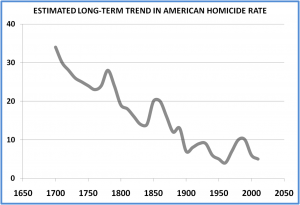
  4. But of course airports aren't the only places where this shit happens. We are being taught constantly to be afraid, as if the world we live in has grown insanely dangerous now. What, tell me, has changed in the dangers of our day to day life from 20 or 30 years ago? It's not like we just invented firearms. It's not as if there were no murderers in those distant past years.  Look:


    There were plenty of drugs, and there was plenty of booze... (Note the peak in murders under prohibition... looks like booze is probably a good thing to have legal) There were school bullies then too. Why is it that we are only now confronted with metal-detectors in elementary schools, lawsuits against name-callers, and an urgent warning never to allow our addresses to be known? 

Saturday, April 23, 2011

Rhetoric and Reality

One of the things that bothers me most about politics is the spectacular manner in which our leaders manage to use a shared rhetoric to pursue conflicting policy.  This infuriates me for several reasons. It occludes the real issues, it demonstrates hypocrisy in our system, and it fills debates with sound bytes rather than discourse.  That all sucks, but the thing that annoys me about it most is that it makes it painfully clear that our politicians believe that the American public has a broadly shared set of values.  If that's the case then why aren't we able to agree on a single damn thing?  If we have the same goals, the debate should only be about the most effective means to meeting those goals, and we have all sorts of tools for measuring progress towards them.  Let's look at some examples.

Freedom - I'd say freedom is a pretty much universally lipserviced American value, though when it comes down to it we appear chronically incapable of passing beyond rhetoric on this subject.  Here's an interesting commentary on the issue: http://www.slate.com/id/2291847/  Basically, we always talk about how free America is - we seem to value that quality highly - yet when asked to make specific policies to enhance the freedom of the American people, our politicians routinely balk.  Examples abound in the article and in recent political history: Patriot Act, all sorts of fancy shmancy warrant-less acquisition of electronic communication.  Maybe politicians have recognized that we don't actually value our freedom as much as we value hearing the word freedom in the context of pro-American rhetoric.

Opportunity - If I had a dollar for every time a politician used the phrase "American Dream" I would have very many dollars, maybe even enough to run for office.  So far as I can tell, the American Dream is basically about upward mobility.  If not "Rags to Riches" then at least "Rags to House-Lawn-and-Cable-TV".  Too bad we're not doing too well on that metric: https://docs.google.com/viewer?url=http%3A%2F%2Fwww.oecd.org%2Fdataoecd%2F2%2F7%2F45002641.pdf

I'm not really sure what we should do about this sort of nonsense, other than be more explicit about our goals, the relationships between our goals and proposed legislation, and the measured impact of enacted legislation upon those goals.  Good luck getting any of that passed through our legal system.